Replacing an old patio, walkway or slab usually begins with a question: What happens to the concrete that is already there? The finished pour is the exciting part, but removing the existing surface correctly is just as important.
Replacing an old patio, walkway or slab usually begins with a question: What happens to the concrete that is already there? The finished pour is the exciting part, but removing the existing surface correctly is just as important.
For homeowners and commercial property owners in Fort Collins, Loveland, Windsor and nearby Northern Colorado communities, concrete demolition can involve much more than breaking a slab into pieces. The crew must protect nearby features, identify underground obstacles, control debris, haul away material and prepare the ground for whatever comes next.
Quick answer: What does professional concrete removal include? A typical project includes a site inspection, utility and access planning, controlled demolition, debris loading, haul-away and cleanup. If new concrete is being installed, the exposed base is then evaluated for grading, stability and drainage before forms and reinforcement are set.
When Should Old Concrete Be Removed?
Concrete can become a problem when it no longer supports the way you use your property. Common reasons for removal include severely cracked slabs, uneven walking surfaces, failing edges, unwanted patio layouts and drainage that sends water toward a building.
Removal may also be needed even when the old surface looks acceptable. A homeowner might want a larger patio, a different walkway alignment, better access to a side gate or a new pad for an outdoor feature. Sometimes the existing slab is simply in the wrong place for a planned improvement.
The decision should be based on the whole site, not appearance alone. A contractor should consider the condition of the concrete, the material beneath it, nearby utilities and whether the replacement will solve the original problem.
Step 1: Evaluate the Existing Concrete and Surroundings
Before equipment arrives, the crew should walk the area and determine what must stay intact. That might include a garage foundation, retaining wall, porch, landscaping, irrigation, fence, utility box or adjacent pavement.
Questions to settle early include:
- How thick is the slab, and does it contain reinforcement?
- Is the concrete attached to another structure?
- How will equipment reach the work area?
- Where can removed material be loaded safely?
- Are there sprinklers, utilities or drainage lines nearby?
- Will the project require work in or near a public right-of-way?
In Northern Colorado, access can be a major cost and scheduling factor. A backyard with a narrow gate is a different project from a driveway that equipment can approach directly.
Step 2: Locate Utilities and Plan a Safe Work Area
Concrete demolition may involve excavation around slabs, footings and underground features. Colorado 811 recommends contacting 811 before digging, even for relatively small projects. A standard public utility locate does not necessarily identify private irrigation, lighting or other privately owned lines.
The work area should also be organized to protect people, pets and property. Dust and noise are normal parts of demolition, but controlled methods, safe equipment operation and good debris management reduce unnecessary disruption.
Homeowners can help by clearing vehicles, furniture, planters and movable decorations before work begins. If access to the garage or front door will be interrupted, discuss a practical alternative route in advance.
Step 3: Saw-Cut, Break Up and Remove the Slab
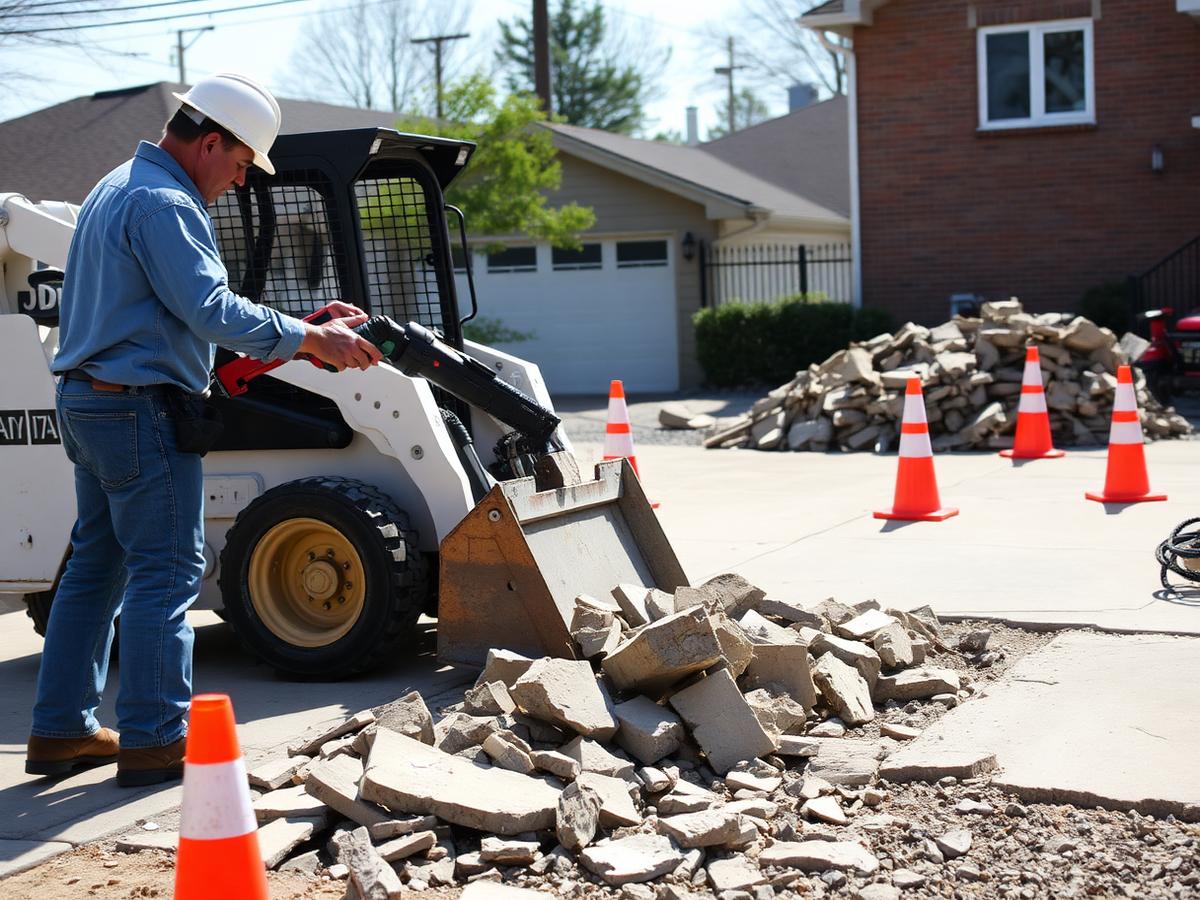
The removal method depends on the size, thickness and position of the concrete. A contractor may saw-cut along a boundary where old concrete must separate cleanly from material that will remain. Sections can then be broken up with suitable equipment and loaded for haul-away.
Careful demolition matters near steps, building edges and adjoining slabs. Breaking too aggressively next to a surface that should stay can create more work than the original project required.
The crew also needs a plan for reinforcing steel, buried debris and unexpected thickness. An accurate estimate should explain what removal and disposal work is included and how unforeseen conditions will be handled.
Step 4: Haul Away Debris and Inspect the Ground
Once concrete is removed, the exposed area tells the next part of the story. Soft soil, poorly compacted fill, standing water, roots or buried debris may not have been visible before demolition.
This is a key advantage of removing a failed slab rather than simply placing new material on top. The contractor can evaluate the support beneath the old concrete and address conditions that might otherwise affect the replacement.
Haul-away should be included clearly in the project scope. Ask whether the crew will remove all broken concrete, leftover material and related debris, and what condition the site will be in when work is complete.
Step 5: Prepare for the Replacement Pour
If a new driveway, patio or walkway follows demolition, the exposed ground needs proper preparation. Depending on site conditions, that may include excavation, removal of unsuitable material, drainage adjustments, compacted base material, forming and reinforcement.
An attractive concrete finish cannot compensate for an unstable foundation underneath. Northern Colorado's changing temperatures and freeze-thaw cycles make base preparation especially important. The contractor should also plan where water will go after the new elevations are established.
What Affects Concrete Removal Cost?
Square footage is one factor, but it is not the only one. Demolition pricing may change based on slab thickness, reinforcement, equipment access, disposal volume, proximity to buildings and whether excavation or additional site work is required.
A fair comparison between quotes should cover demolition, loading, disposal, surface protection, cleanup and preparation for the next phase. The lowest price is not necessarily the best value if those tasks are left out.
Frequently Asked Questions
Can you pour new concrete directly over old concrete?
An overlay may be appropriate in some situations, but a new slab over unstable, badly damaged or poorly drained concrete can inherit the same underlying problems. A site evaluation should determine whether removal is the better option.
How long does concrete demolition take?
It depends on the size, thickness, access and disposal plan. Small accessible areas can move quickly, while reinforced slabs or tight backyards may require more time. Request a timeline based on the actual site.
Does concrete removal include hauling away the debris?
Not always. Confirm that loading, transportation, disposal and final cleanup are included in the written estimate. Skyline Concrete & Services lists full haul-away as part of its concrete removal service.
Start Your New Concrete Project With the Right Preparation
A successful replacement starts long before fresh concrete reaches the site. Safe removal, an honest look at the ground underneath and a clear drainage plan help create the conditions for lasting flatwork.
Skyline Concrete & Services handles concrete demolition, haul-away and new concrete work in Fort Collins, Loveland, Windsor, Timnath and surrounding Northern Colorado communities. Request a free on-site quote for your removal or replacement project.